Key Learning Points
-
Instant payments are rapidly shifting from a mere convenience to an absolute essential for daily financial life in Suriname, Guyana, and the wider Caribbean.
-
Beyond speed, these systems directly address critical regional challenges like limited banking access, cash risks, and the high costs and delays of traditional remittances.
-
Immediate fund access revolutionizes personal budgeting, provides crucial emergency funds, and gives small businesses vital cash flow for growth.
-
Overcoming barriers through education, accessible infrastructure (especially mobile-first), and supportive government policies is crucial for widespread benefit.
Transforming Financial Lives in Suriname, Guyana, and the Caribbean. The way we handle money is undergoing a seismic shift. For too long, waiting days for payments to clear or struggling to access funds in an emergency has been the unwelcome norm.
But things are changing. Instant payments—the ability to send and receive money in seconds—rapidly move from a convenient "nice-to-have" to an absolute "must-have." This is especially true for dynamic, growing economies like Suriname, Guyana, and the wider Caribbean.
The Caribbean's Financial Revolution is Here
From Cash Kingdoms to Digital Powerhouses
Historically, many Caribbean nations have relied heavily on the cash model despite its inherent limitations—security risks, inconvenience, and slower commerce. However, a digital wave is now sweeping the region.
Between 2021 and 2023, payment preferences in Latin America and the Caribbean shifted dramatically. Cash usage dropped significantly, while debit cards, credit cards, and mobile payments more than doubled in use. By 2023, debit cards emerged as the preferred payment method in Spanish-speaking Latin America.
There’s a clear shift in consumer behavior and a readiness to embrace faster, more efficient ways of managing money. A 2023 Mastercard study further highlighted this, revealing that 55% of Latin American consumers use debit cards.
Success Story: A collaboration between the Central Bank of Barbados and financial institutions like CIBC FirstCaribbean has resulted in an instant payment system, which allows transfers to other banks and credit unions in three minutes or less.
Setting a regional benchmark, this system demonstrates the tangible benefits of real-time payments for both individuals and businesses, making financial transactions more convenient, cost-effective, and timely.
These shifts have profound implications for Suriname and Guyana. As these nations develop and integrate into the global economy, the demand for instant and reliable financial infrastructure will grow.
What Instant Payments Mean for You
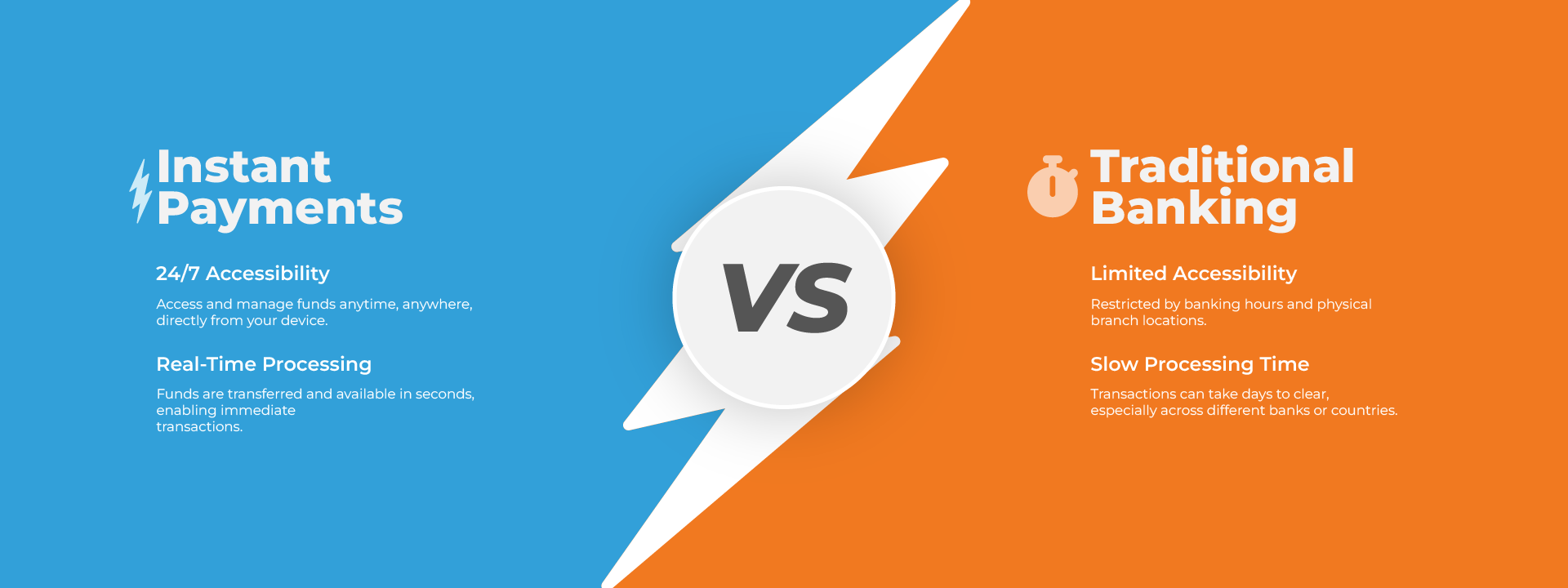
| Traditional Banking | Instant Payments |
|---|---|
| Transfers could take 3-5 business days. | Funds move in seconds, not days. |
| Transfers are processed in batches at specific times. | Processed in real-time as they occur. |
| Operate under traditional banking hours. | Banking hours? A thing of the past. |
| Limited accessibility. | 24/7/365 accessibility |
Why Your Geographic Location Makes This Even More Critical
For the people in Suriname, Guyana, and the Caribbean, the promise of instant payments isn’t just about speed; it’s about leveling up the playing field with the rest of the world. Tapping opportunities and possibilities that were previously out of reach is the real win here.
The Unique Challenges of Suriname and Guyana
-
Remote Area Banking Limitations: In both Suriname and Guyana, physical bank branches are few and far between and often concentrated in urban centers. If you live in a remote village or the interior, accessing banking services can be a tiring and costly affair. A 2022 survey found that, although 72% of adults in Suriname were financially included, challenges still exist in remote areas. Access to finance is a key challenge for businesses in Suriname. In 2018, 25.9% of firms cited it as their main obstacle. The 2021 IFPG survey found that access to digital payments became a major constraint during the pandemic. Instant payments, often accessible via mobile phones, can bring the bank to people.
-
Cash Dependency: Relying heavily on cash is not only inconvenient; it is also risky and susceptible to crime. There are unstated costs associated with handling cash: storage and security for businesses and the time and cost of access for individuals. Suriname, for example, has a large informal economy and a strong cash culture, especially in remote areas. The Central Bank of Suriname is even aiming for a 30% reduction in cash usage.
Guyana, another heavily cash-influenced economy, is pushing for a more digital economy through its modernized National Payments System.
-
Infrastructure Gaps: Connectivity in the interior of Suriname requires heavy investment in telecommunications and energy infrastructure. Remote communities are underserved and have limited access due to limited road access and dense forest. Suriname scores lower than the global average in the UN DESA's e-Government Survey for telecommunication infrastructure.
-
Low Financial Literacy: The financial literacy rate varies significantly across demographic groups, with vulnerable groups, who stand to gain the most from financial literacy, lagging far behind. Approximately 32% of people over 18 in Suriname lack a bank account, mainly due to a lack of confidence in the banking system and unfamiliarity with its benefits.
-
Gaps in Digital Payment and Card Infrastructure:
-
Card Payment Challenges: limited global acceptance, lack of e-commerce support, slow EMV adoption.
-
Electronic Transfers: no real-time low-value ACH, poor mobile app integration.
-
Online Payments: not available for all merchants due to integration issues.
-
Regional Success Stories Already Happening
-
CIBC FirstCaribbean in Barbados: As mentioned, their instant payments system allows fund transfers within three minutes. This demonstrates tangible success within the Caribbean Community (CARICOM) region.
-
Brazil’s PIX Phenomenon:
-
Pix positions Brazil as a leader in instant payments, ranking second globally with 15% of all transactions in 2022.
-
As of March 2024, 15 million businesses and about 153 million Brazilians, or 75% of the population, were using Pix.
-
In 2024, Pix handled over 6 billion transactions per month and approximately 57 billion transactions, totaling around US$3.8 trillion in total.
-
In February 2024, R$1.4 trillion ($283 billion) was processed through Pix, a 57% year-on-year increase.
-
Person-to-Business (P2B) payments, driven by consumers' preference for instant payments, have seen a 94% YOY growth.
-
Business-to-Business (B2B) Pix transactions exceeded R$1 trillion in December 2024, a 56% increase from the previous year.
-
-
Mexico's DiMo and Paraguay's SPI:
-
Dinero Móvil (DiMo) is a new real-time payment solution implemented by Mexico in place of the previous system, CoDi.
-
DiMo allows users to make payments using only the recipient's phone number. No need for QR codes or account numbers.
-
DiMo is projected to grow by 19% annually between 2023 and 2027.
-
Paraguay’s SPI, launched in 2022, offers similar free, instant, 24/7 services and has seen rapid adoption.
-
In just two years, the average daily transactions on the SPI quadrupled, from 141,000 to 560,000 by August 2024.
-
By September 2024, 26% of active accounts in Paraguay were using the SPI.
-
These examples show different approaches leading to greater financial empowerment in the region.
Real-World Scenarios Where Instant Payments Transform Lives
Let’s move beyond theory. How does this actually make a difference in your day-to-day life?
The Emergency Fund Access Crisis
| Scenario | Traditional Solution | Instant Payment Solution |
|---|---|---|
| A sudden medical emergency strikes a family in a rural part of Guyana, hours away from the nearest bank branch. | Trying to find someone to lend cash. / Long journey to the bank. / Potentially days waiting for a transfer from a relative to clear. / Precious time is lost | A family member overseas uses an instant payment tool like YU-Pay to send funds using just a mobile number. / Funds arrive instantly, not in days. |
The Remittance Revolution
| Scenario | Traditional Solution | Instant Payment Solution |
|---|---|---|
| Many Caribbean families rely on money sent from loved ones abroad. / Imagine a family in Suriname needing urgent funds from abroad to meet an unexpected bill | Imagine a family in Suriname needing urgent funds from abroad to meet an unexpected bill. / Long wait of 3 days or more. / Slow and expensive process. | Significantly lower fee of around 4.6% or even lower / Funds arrive instantly, not in days |
The Small Business Cash Flow Game-Changer
| Scenario | Traditional Solution | Instant Payment Solution |
|---|---|---|
| A small business owner in Georgetown's Stabroek Market needs to restock inventory quickly after a busy day. | He might have to wait days for customer payments to clear before buying new goods. / A long wait means missed sales opportunities | With instant payments, money from sales is available almost immediately / They can reinvest in their business within minutes, keeping shelves stocked and customers happy |
How Instant Payments Transform Personal Finance Management
Improved Cash Flow
-
No more "counting down the days to payday"—pay dues and bills as and when they arise.
-
Handle unexpected expenses (broken car, school trip, home renovations, etc.) immediately—no more waiting days for funds.
-
Faster payments mean businesses and individuals have access to funds more quickly, enabling better cash flow management and more informed budgeting decisions.
-
Reduced dependency on high-interest short-term loans/informal lenders.
Enhanced Financial Security
-
No more bulky wallets: Say goodbye to carrying large amounts of cash.
-
Fraud Protection: Instant payment systems let you track your money and know exactly what’s happening with the user’s account instantly. For example, YU-Pay[1] transactions require OTP-based authentication to proceed. With real-time notifications, YU-Pay users are always in the loop and in complete control.
-
Reduced risk of theft or loss: Digital money is inherently more secure than physical cash.
Better Budgeting and Money Management
Instant payments provide immediate and real-time visibility into income and expenses. This awareness allows for more accurate budgeting, tracking, and informed spending.
Overcoming Regional Barriers to Adoption
The shift to instant payments is revolutionary, but success hinges on dismantling existing hurdles. Proactive strategies are essential to ensure inclusive adoption across Suriname, Guyana, and the Caribbean.
| Barrier | The Challenge | Solution & Evidence |
|---|---|---|
| Trust & Digital Literacy | Digital skepticism / Cash preference / Unfamiliarity & security concerns | Action: Transparent fees, security education. / Model: Brazil's PIX achieved 85% adult adoption via Central Bank trust & clear utility. |
| Infrastructure & Access | Uneven connectivity in rural & remote areas / Data/device costs & compatibility | Action: Mobile-first design; government investment. / Data: Suriname is experiencing a high mobile penetration rate of over 100%. Suriname is pushing for a digital transformation through the National Digital Strategy 2030. Guyana, too, is pushing for comprehensive digital inclusion through the ICT Masterplan 2030. |
| Regulatory Framework | Need for clear, supportive regulations that foster innovation. / Safeguarding consumer interests and financial stability. | Action: Agile policies; Central Bank leadership. Example: CBvS Financial Inclusion Bill; successful frameworks inspiring regional best practices. |
By addressing these challenges directly, we pave the way for widespread, inclusive adoption and tap the full economic power of instant payments.
The Road Ahead: What This Means for You
The shift to instant payments is not a matter of if, but when. And "when" is rapidly becoming now.
Preparing for the Inevitable Shift
| Get curious | Skill up | Platform choice |
|---|---|---|
| Start learning about the digital payment options available. | Basic digital literacy will be as important as knowing how to count cash. | Look for platforms that are user-friendly, secure, and have clear terms. |
| What apps are out there? Which banks offer instant transfers? | Learn to compare FX rates, set biometric security, and use budgeting tools. | Prioritize PCI-DSS-certified apps with 24/7 support, low fees, and FX rates. |
The Competitive Advantage of Early Adoption
Better deals: Early adopters often benefit from introductory offers, better rates, or lower fees.
Priority access to innovation: Gain entry to the latest features and services as they become available.
Future-proof your finances: Building digital financial literacy now prepares you for even more advanced financial tools and opportunities down the road.
Your Next Steps in the Instant Payment Era
Ready to join the revolution? Here’s your roadmap.
Practical Action Items
-
Do your homework: Research the instant payment options available in Suriname and Guyana. Ask your bank, look for mobile money services, and see what’s being discussed online and in your community.
-
Start small: Not sure about it? Try sending a small amount to a friend or family member to see how it works. Send $10 via YU-Pay to a relative—experience <8-second transfers. Build your confidence one transaction at a time.
-
Fee Audit: Use the World Bank’s Remittance Prices comparison chart to compare remittance costs.
YU-Pay boasts a flat fee of $15/transfer for international bank transfers, irrespective of the amount. Domestic transfer fees are as low as 0.8% (capped at $5).
-
Spread the word: Talk to your family, friends, and business contacts about the benefits. The more people who use these systems, the more useful they become for everyone.
The Bottom Line
Instant payments are not just a passing trend; they signify a paradigm shift towards genuine economic empowerment for individuals across Suriname, Guyana, and the wider Caribbean. Consider Pix. Adopted by 75% of the population and 15 million businesses, and having processed nearly 57 billion transactions in 2024, it has transformed financial access and inclusion on a national level. This isn’t solely about speed; it’s about addressing financial stress—where immediate access to funds can determine the difference between crisis and stability.
With remittance costs significantly below the global average of 6%, the Caribbean is already experiencing a transformation, as demonstrated by initiatives such as DiMo & SPI and CIBC FirstCaribbean's quick transfers in Barbados. Governments in Suriname and Guyana are actively pursuing a modernized digital financial ecosystem. Suriname aims for a 30% reduction in cash usage, and Guyana is overhauling its systems.
The direction is clear. Clinging to outdated methods will no longer suffice. Instant payments are a critical step towards individual financial resilience and broader economic vitality for our nations.